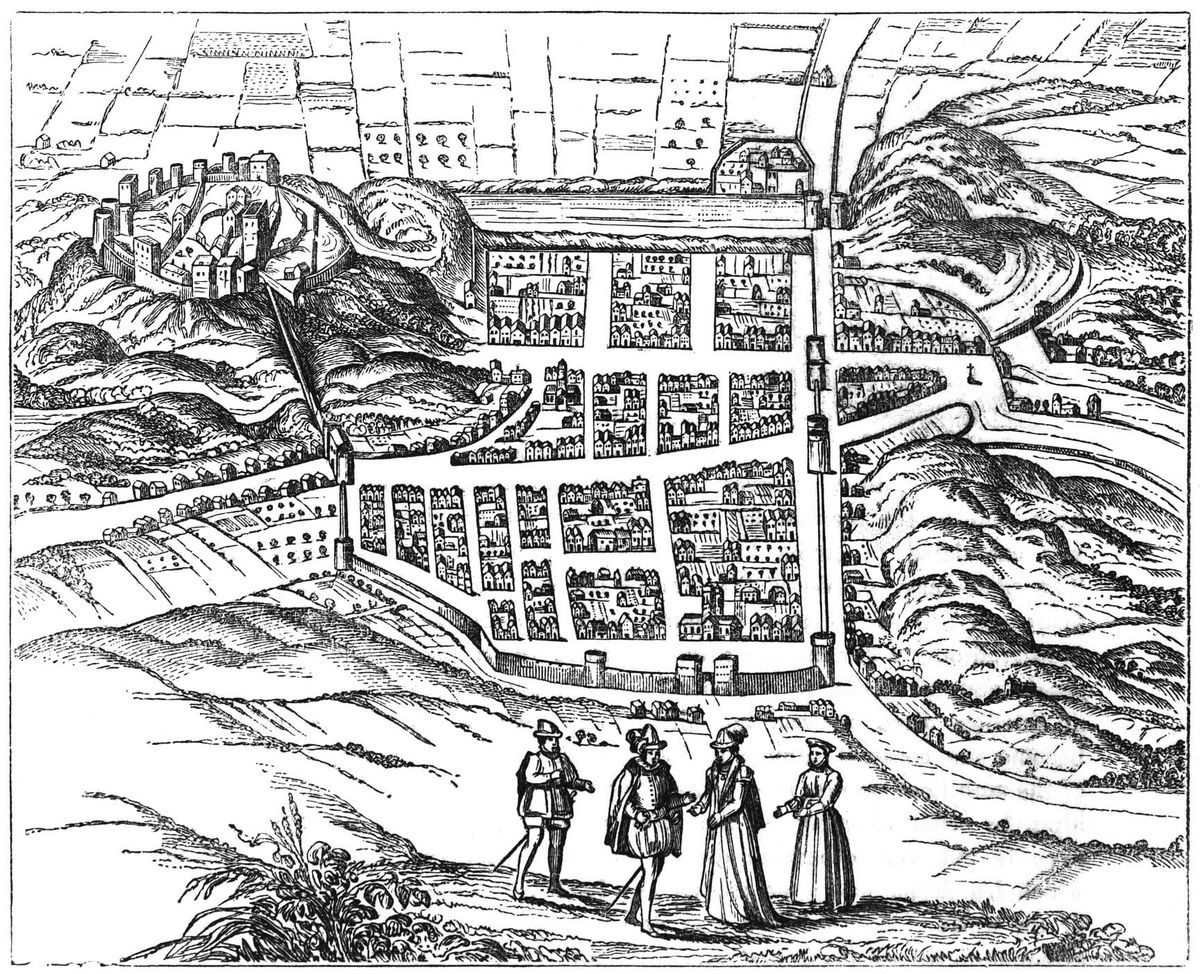
Old Town Edinburgh
Although today it has as many tourists as rats, Old Town caught my attention the moment I started researching Edinburgh. As you explore Old Town — or in my case, get lost — it’s not uncommon to walk past what appear to be four-story buildings built in the sixteen or seventeen hundreds. If you could only slip around the back of those buildings, the additional four to six stories below street level would astonish you.
Penned in by its walls, Edinburgh built up, up, up. One census conducted in 1707 found forty thousand people lived in the one hundred and forty acres. My wife and I grew up on opposite sides of the United States in houses with ¾ of an acre of property. Instead of the five people from my family living on that property, Edinburgh had two hundred and fourteen. That’s insane. In 1750, the density had risen to 1.5 people per square yard in tenements often rising eleven to fifteen stories.
Once the city walls no longer hemmed in the population, the official census records from the nineteenth century are clear: Edinburgh’s population soared. Development of New Town and migration to the cities drove population growth early in the century, while overcrowding and migration to America caused growth to slow in the middle of the century. Finally, as sanitation and housing improved near the end of the century, the population climbed once again.

People are people
Just because they didn’t start their day with a shower and didn’t have the luxury of flush toilets until the late nineteenth century, doesn’t mean residents of Edinburgh weren’t like us. They had jobs, kept animals, and committed crimes.
Traditionally, brewing ale and beer had been women’s work, but the founding of the Edinburgh Society of Brewers in 1596 brought even greater profits, regulation, and men to the industry. Isn’t it shocking how as soon as something becomes profitable, it’s no longer women’s work? Alehouses were both popular and essential, because until the work of John Snow in 1854, no one knew why the water was unsafe. That meant competition. And nothing beats a little astroturf endorsement.
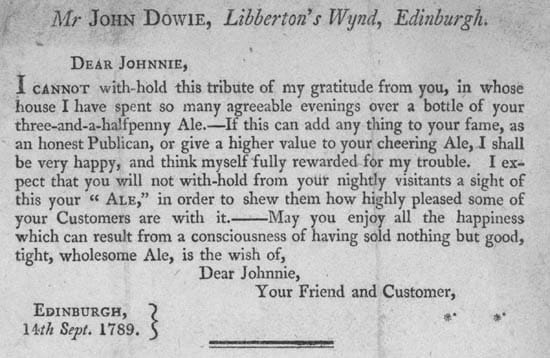
In 1789, only the most gullible would believe a customer paid to place the preceding endorsement in an Edinburgh broadside. Libberton’s Wynd was one of the many locations where Edinburgh conducted public executions. Nothing works up a thirst like an execution. How fortunate for spectators that they know where to find “good, tight, wholesome Ale” nearby.
Of course, we now think public executions are barbaric, but at least the courts would only execute a criminal for the most heinous crimes. Right? With a population as dense as Old Town’s, Edinburgh didn’t have prison facilities until the end of the 1700s. The court might hold a criminal pending trial, but once found guilty, there is one primary punishment.
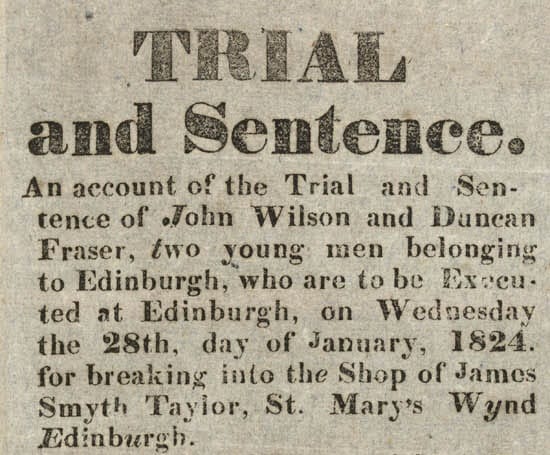
If you search the broadsides for executions, you’ll find crimes that today would earn the perpetrators a short stint in pokey, not a short, sharp drop. Opened in 1817 and expanded in 1859, Jules Verne described Calton Prison as a medieval town. Incarcerated prisoners described it as hell. A prisoner held there during World War I put it this way:
[Calton is] by far the worst prison in Scotland; cold, silent and repellent. Its discipline was extremely harsh, and the diet atrocious.
Pollution
For someone raised with twentieth or twenty-first century standards, Old Town Edinburgh wasn’t a nice place to live. As you’d expect with so many people crammed in cheek-by-jowl, it was dirty and smelly.
Until the middle of the eighteenth century, walls surrounded Edinburgh. We don’t think about the consequences of having walls around our cities, but once the doors were closed, nothing entered or exited. That meant everything the city needed had to be inside the city. Just in case. Cows. Chickens. Pigs. And everything that cows, chickens, and pigs produce.
Built on a grand hill, gravity took care of the waste products of Edinburgh’s livestock. And if the wynds and closes could handle faeces, urine, and blood from the city’s animals, why not the contents of its chamber pots?
One of my favourite bars started its life in the early 1800s as a cowshed providing milk for the neighbourhood. Watery, unwholesome milk, but well… a milk-like substance. And as recently as 1900, Edinburgh still had one hundred and fifteen licensed — licensed! — cow sheds with roughly three thousand cows. That’s a lot of poo.
Don’t worry! The waste after leaving the wynds and closes flowed into the Nor Loch, the Water of Leith, or other water sources for the locals. No wonder beer and ale sold so well.
Maybe you’re optimistic your exalted station in life will entitle you to avoid the flow of effluent. As Robert Louis Stevenson wrote of standing on South Bridge:
“To look over the South Bridge and see the Cowgate below full of crying hawkers, is to view one rank of society from another in the twinkling of an eye.”
But no one escaped the smog. Heating Edinburgh required coal. Smelting iron required coal. Industry required coal. And burning coal produced a thick, soupy smog — a term coined after a catastrophic fog over Glasgow and Edinburgh in 1909. In London, the daily mortality rate doubled during the 1880s during the worst fogs. As early as the 1850s, links to the use of coal were apparent in higher mortality rates from respiratory diseases among all ages, but particularly the old and young. For every 1% increase in the intensity of coal usage in a region, the infant mortality rate increased by one child in a hundred.
But atmospheric pollution doesn’t just kill. As young men born in the 1890s enlisted in the British Army to serve in World War I, although the average height was five feet six inches, those who grew up in the heaviest coal-using regions were on average an inch shorter. This difference was more than twice as much as that observed between the children of white-collar and manual labour. Smoking does stunt your growth, kids.
Not a nice place to live
Ultimately, I’d like you to believe my decision for where to set my story was complex and dependent on issues essential to the plot. But the truth is much less flattering: Old Town Edinburgh just wasn’t a nice place to live.
I’m writing a historical fantasy, which means I’m free to leave out any details that make my rendition of Victorian Edinburgh less interesting. Nothing compels me to include the noisome rivulets running down the middle of the wynds or the 10pm deluge. I can ignore the gallows and gibbets. But the more I learnt about Old Town during that time, the less it fascinated me. Who would want to get Burked on their way home from a Den?
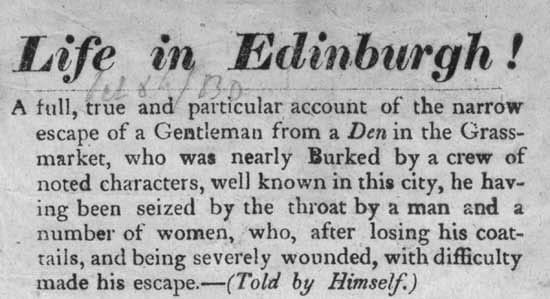
So, just like everyone else in the 1800s, my attention fled to New Town.