History or Fiction
I love a good historical fiction novel. There’s nothing better than feeling the sense of place long gone, getting to know people who strode this planet long before I did, all while reading a captivating tale. I still recall reading a book that took place in the thirteenth century, full of sieges and sackings of towns in Brittany. A key part of the plot was the involvement of a heretical Christian sect. I could almost smell the smoke of burning buildings, the copper tang of blood pooling on the ground, and the fetid mud left behind by hundreds of horses and oxen.
As I sat down to plan my story, I wanted to evoke that same sort of sensory experience. When my characters walk the streets of late nineteenth-century Edinburgh, I want you to feel the pavements beneath your feet and the honey-coloured sandstone townhouses rising up around you. When they head home to a cosy townhouse with well-worn rugs on the floor and comfortable leather chairs placed to perfectly catch the afternoon sun, I want you to wish to be there, just a little bit.
They got smog, sewage, and mud
Oh you landsman and you seamen come listen to my song,
It’s of a trick was played on me, it won’t delay you long
I came from the sea the other day, a fair girl I did meet
She kindly asked me to a dance was up on Peter Street.
Pavements might be the province of pedestrians, but the streets were the kingdom of the horse. Set foot there and anything might happen. At best, you might pull back a boot with a smelly accretion. At the worst, you might slip and fall into the smelly mire. Honestly, I can think of nothing worse. Fortunately, large cities offered crossing sweepers who would precede pedestrians and sweep their path clean for a small gratuity. No one would force you to accept the aid of a crossing sweep. You were welcome to scrape your boots when you arrived at your destination and just be smelly all day long. You do you.
But there’s no denying that crossing a street full of horse droppings means tracking something foul into the home. No matter how hard you struggle with the boot scraper.
Don’t breathe the air
And it’s go boys go!
They’ll time your every breath.
And every day you’re in this place
You’re two days nearer death.
But you go!
Well a process man am I and I’m telling you no lie,
I work and breathe among the fumes that tread across the sky.
There’s thunder all around me and a poison in the air,
There’s a lousy smell that smacks of hell and dust all in me hair.
Coal and coke fired the steam engines and gas lights that defined the Industrial Revolution and the nineteenth-century. There’s certainly room to argue that, like every other major leap in technology, those holding the reins took advantage of those yoked to the harnesses. But as society burned more and more coal, the downsides became more obvious. After a catastrophic fog smothered Glasgow and Edinburgh in 1909, Des Voeux coined the term smog for a smoky fog. That fog lasted mere days, but killed over two thousand people. TWO THOUSAND PEOPLE.
As early as 1850, British authorities had statistics showing that an increase of 1% in coal usage intensity equated to an increase of one additional infant death in 100. Soldiers enlisting for service in WWI, who were born in the 1890s, averaged 168cm tall. However, soldiers who grew up in the most polluted districts were 2 to 3cm shorter than the average. This difference was twice as great as the difference between children of white-collar and manual labour parents.
Accounts of the late nineteenth-century include needing artificial lighting in the summer as early as 1pm and all day in the winter. I wanted to depict scenes where my characters could smell blossoming flowers, enjoy the songs of courting birds in the trees, and stroll outdoors in the early evening. If I stuck to history, they’d be picking up the bodies of dead birds, brushing soot off withering plants, and peering cautiously ahead with a lantern at noon. So I left out the smog.
Don’t drink the water
If all you young men were ducks in the water,
How many young girls would undress and dive after?
If all you young men were hares on the mountain,
How many young girls would take guns and go hunting?
If all you young men were hares on the mountain…
The main character of my story frequents a bench overlooking the Water of Leith. He retreats here before the climax to decide how to handle the villain. This is where he debates running away when things get tough. It’s not unreasonable to suggest this is one of the more important locations in the story. But at the time of the story, 1881, the Water of Leith was disgusting.
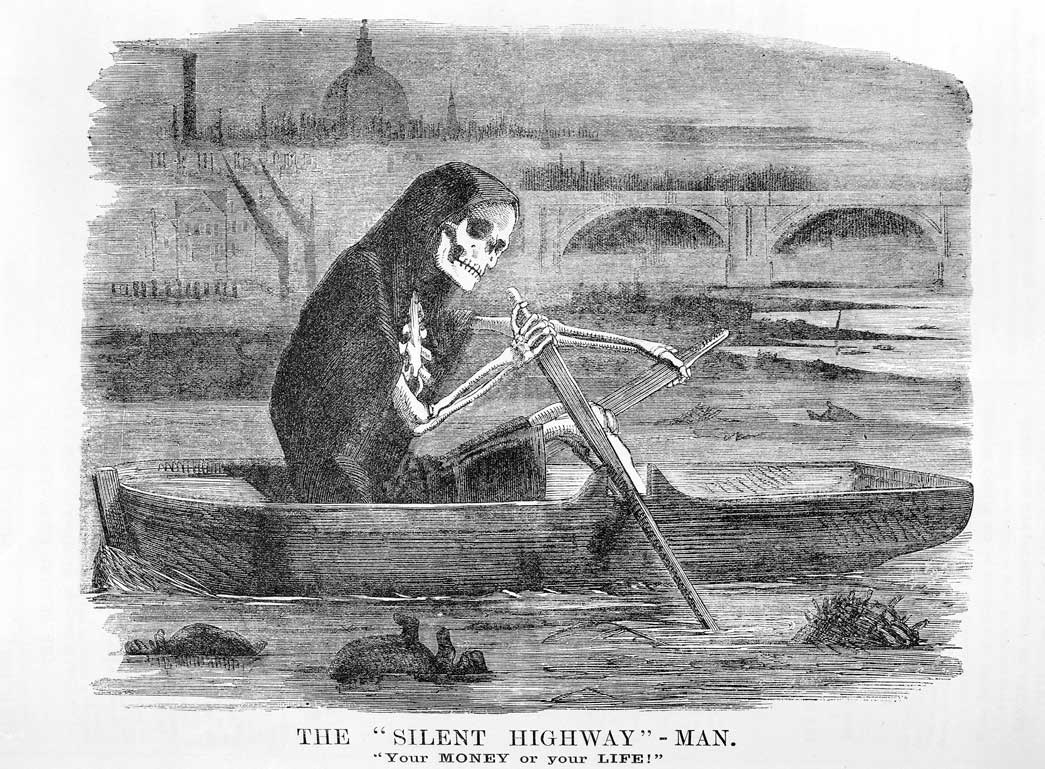
The vast majority of sewage from the south side of Old Edinburgh drained into what is now The Meadows and from there westward into the Water of Leith. Our twenty-first century sensibilities consider allowing raw sewage to flow into rivers unbelievable — although sewage spills in England still seem common enough — but in the nineteenth century, the prevailing attitude was “God put the rivers there to carry our waste to the sea”. This meant locating mills, distilleries, tanneries, and chemical works in Roseburn where they could empty directly into the river. Unfortunately, the Water of Leith made a particularly poor sewer at the time, because its flow dropped to a trickle in the summer.
Mostly, locals considered this a nuisance. The sight and smell of accumulating sewage on the riverbed was just a price of progress. But during the Second Cholera Epidemic of 1848–49, proof emerged that contaminated water played a pivotal role in spreading the disease. Oops.
Edinburgh’s industry fought an 1854 act to clean up the Water of Leith and improve the flow of sewage down the river to Leith, where the stinky mud accumulated. Wee! Later, after two more years of legal wrangling, the Edinburgh and Leith Sewerage Act passed in 1864. Can you imagine Edinburgh didn’t want to pay for cleaning up its own poop? The 1864 act cleared the way to build intercepter sewers.
The interceptor sewers literally intercepted the original sewers before they could discharge into the Water of Leith and then carry the waste elsewhere, the Firth of Forth. This took three years to complete, and it mostly worked. However, not everything made it into the sewers. The mills, tanneries, and other industries held out. And in 1884, a survey found a glob of human excrement four feet deep and liquid waste a further seven feet deep had accumulated behind the Coltbridge mill dam. Yuck.
In 1885, the Edinburgh Corporation certified the dam as a public health nuisance, and the presiding officer said:
A deposit of putrescent sewage and other decomposing organic matter [which] is continually evolving noxious gases and germs, of a nature to produce and provoke miasmatic and malarious disease, and to endanger the health of persons who reside in, or who have occasion to frequent the neighbourhood.
In 1889, the Water of Leith Purification and Sewerage Act went before parliament, and although the mill owners and industries along the Water of Leith opposed the dreadful infringement of their God-given right to dump shit into the water, the act passed.
The 1889 act was so successful that by 1896, the Edinburgh Corporation needed to pass by-laws to protect fishing rights in the Water of Leith. FISH! Where previously there’d only been poop. That’s progress.
Fact or fiction
I set this story in 1881. If sitting beside the Water of Leith is so important, why not set the story later? Even more of what we consider emblematic of the Victorian era appeared after the 1890s, like enamelled clawfoot tubs and steam-powered trams.
However, a crucial plot point is the refusal of the University of Edinburgh to admit women to their medical school. By the late 1890s, this was no longer a problem. The Edinburgh School of Medicine for Women opened in 1886 and lasted until 1898. And the University of Edinburgh saw the error of their ways in 1892.
Fortunately, I’m writing historical fiction (or, as my wife reminds me, historical fantasy, because I’m fairly certain Edinburgh wasn’t home to a djinn during the late nineteenth century). That means I’m not obliged to include the smog, the poop in the streets, or the sewage in the streams. I struggled in so many other ways to be faithful to the era, but I wanted a bright, fun, and above all cosy place for my characters to live. Somewhere that reminds me of the home I enjoyed.