Mining the broadsides
Until the middle of the nineteenth century, the lucky literate few got their news, gossip, and entertainment from broadsides. Publishers printed these large, single sheets of cheap paper on only one side, perfect for spreading flat or tacking up in public places, and then throwing away. Just as the Internet got its start as a place for serious academic research and quickly devolved into the exchange of cat photos, at first broadsides were for the exclusive posting of royal proclamations and official notices. But as years passed, they became a vehicle for popular culture and political agitation.
The National Library of Scotland has an indispensable, digital archive of the broadsides published in Scotland. We’re incredibly fortunate these disposable documents survived for hundreds of years. They offer remarkable insight into the times in which they flourished.
Catching up on gossip and tragedy
Whether they’re wearing skirts and jeans or handmade dresses and breeches, people are nosy devils who love to devour gossip and salacious accounts of their neighbours. Pinned up in every pub and hawked from every street corner, broadsides were there to satisfy this hunger.
Publishing accounts of scandal and murder had the potential for incredible follow-up sales. One issue might report that a gentleman sprouted a meat cleaver from his forehead, and the speculation on whether it was an accident, self-inflicted, or murder. Then a follow-up issue could recount the adventures of the dashing investigator, with a subsequent issue capturing the nail-biting murder trial of the jealous husband. Finally, ardent readers wouldn’t want to miss the thrilling conclusion: the execution.
You can be certain readers didn’t miss a single broadside account of Burke and Hare:
This day, Wednesday 28th Jan, 1829, William Burke underwent the last sentence of the law, for the murder of Mrs Docherty, one of the victims of the West Port Tragedies.
Report of Burke hanging published 1829
Not everyone loves a good murder, but who can look away from a tragedy? Broadsides published notices of steamboat wrecks, train crashes, and duels (before they went completely out of fashion).
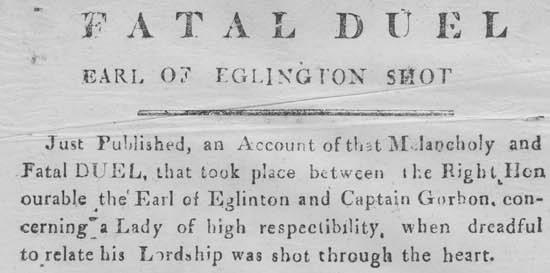
Just like today, a broadside story might embellish or entirely fabricate the details of a story. With the Fatal Duel between the Earl of Eglinton and Captain Gordon, records show the Earl was shot and killed in 1769 in a confrontation rather than in 1829. What’s sixty years between friends?
Ballads
You might think busking is a relatively recent activity, but balladeers and musicians have been entertaining crowds on the street — only to be disappointed when they walk away without leaving a coin or two — for centuries. If you were lucky, the street hawker selling the broadside would sing the ballad available in that issue. If you were very lucky, their voice wouldn’t sound like a cat having a bath.
Maxwelton braes are bonnie,
Where early fa's the dew,
'Twas there that Annie Laurie,
Gi'ed me her promise true.
Gi'ed me her promise true?
Which ne'er forgot will be,
And for bonnie Annie Laurie
I'd lay me down and dee.
First stanza of Annie Laurie published in roughly 1852
Words penned by well-known Scottish writers, like Robert Burns, Allan Ramsay, and Robert Tannahill, appeared in the broadsides. But most ballad and song writers were anonymous. (Sometimes, that’s just as well.)
Humour and satire
Just like today, no-one required the authors of broadsheets to be truthful or serious. As a result, some entries required careful reading lest you end up with one leg longer than the other.
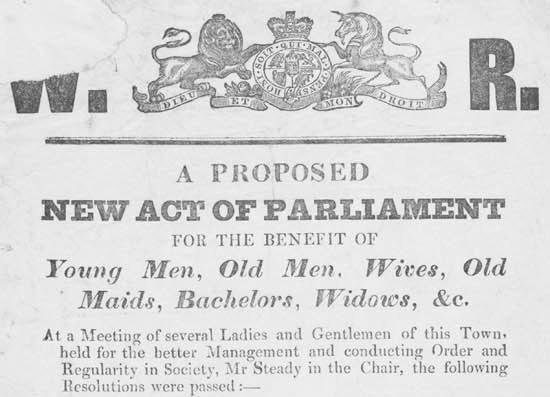
This New Act of Parliament contains several proposals which would surely raise staid Victorian eyebrows. The first clause attempts to address the shocking decline in marriage after women discovered dogs and cats provide more loyalty and affection than a husband.
That no old maid be permitted to keep more than one dozen of lap-dogs, cats, or parrots, to the annoyance of the neighbourhood, but to use every lawful means to procure a husband, but if she can prove to the satisfaction of the court, that she has done so without success, then the court shall be bound to provide her a sleeping partner during the cold nights of Winter.
In the second proposal, I don’t think women should settle for a journeyman’s efforts. However, when you consider the burgeoning prophylactic options available to Victorians, perhaps enthusiastic on-the-job training isn’t so bad.
Any man marrying a woman, and not being able to accomplish the duties of matrimony, the wife shall be empowered to employ a journeyman, the husband presuming to grumble shall be dipped three times a day, in a horse pond, till his wife prove in the family way.
Broadsides for the modern writer
If you’re writing historical fiction or historical fantasy set in the time covered by the broadsides, they can be an invaluable source of local colour. Want to have a character singing a snatch of a popular song? Or talking about the account of a mermaid seen off the Cliff of Cromarry? The broadsides are your resource.
Thanks to the National Library of Scotland, the broadsides have all been digitised and indexed. The archive provides the option to search and browse by subject. But if you’re a nerd like me, performing keyword searches is where it’s at. There might be a monkey in my book. How would Edinburghers have reacted to it? I don’t know, but reading some of the broadside entries gave me a bit of insight.
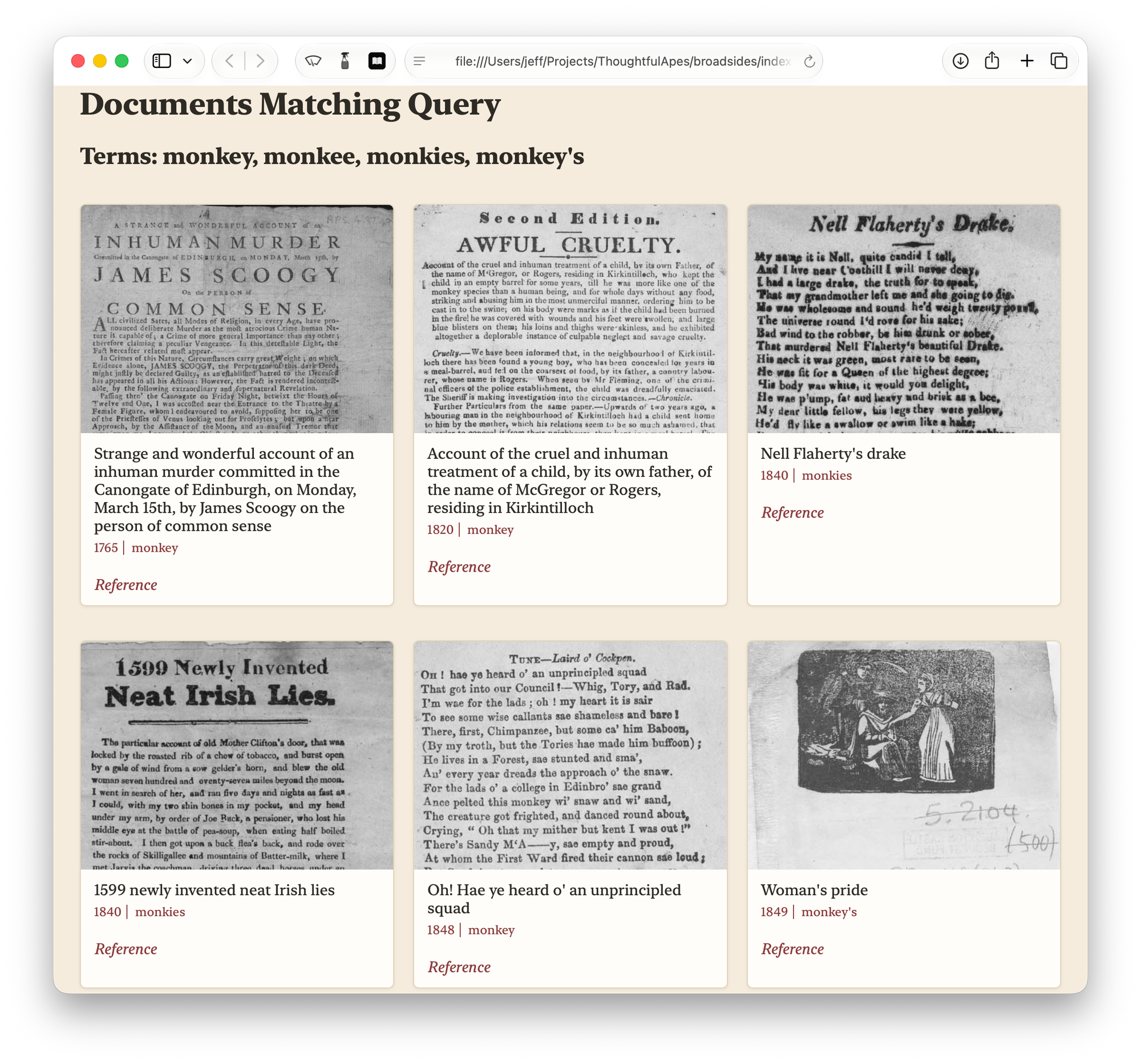
Because I could, I built a small command-line application for Mac to index and search any of the NLS digitised collections. This includes the broadsides, the Ladies’ Edinburgh Debating Society, and the Chapbooks of Scotland. At the moment, the tool is super simple, but it’s enough for my needs.
You can find it on GitHub at https://github.com/jeffwatkins/broadsider. To use this yourself, you’ll need a copy of Xcode and you’ll need to create your own template for the output (the default is junk). But it’s just a start.