A New Town
As the population of Edinburgh expanded within the picturesque medieval city, well-travelled Britons and immigrants expected more from their capital. As the Enlightenment dawned, wealthy and middle-class residents were no longer satisfied living cheek-by-jowl with the poor. Nor did they relish walking through streets literally flowing with blood and excrement.
George Drummond, Lord Provost of Edinburgh, longed to expand the city into the farmlands to the North, but he had hurdles to leap first. Established as one of the earliest royal burghs in the 12th century, Edinburgh developed in proximity to the castle built on the massive rock jutting out of the countryside. Amazing to look at, but if you wanted to get to the fields to the north or south of the city, you first had to travel east down the slope. Ol’ George wanted to extend Edinburgh, not build a separate city. That meant connecting the two was essential.
In the spirit of politicians of every era, George started promoting the idea that would become North Bridge to the citizens of Edinburgh as an “improved road to Leith” in 1763, four years before John Young build the first home in New Town on Thistle Street. As North Bridge neared completion in 1769, the vaults and side-walls of the south end of the structure collapsed, burying five people. When the bridge opened in 1772, residents found leaving the “smokey warmth of old town” for the “bare exposed fields to the north” required a cold and dreary walk.
Competition
Many people in Edinburgh agreed with the idea of a new town but didn’t have the patience to wait for George to push through all the official acts of parliament and get approval for a coordinated town plan. James Brown — no, not The Hardest-Working Man in Show Business — thought he’d get ahead of the official process. He purchased a plot of land south of the city, which the magistrates had previously declined to purchase for the princely sum of £1,200, and advertised houses “in the style of fine mansions”.
The Edinburgh city council knew competition for the official New Town would be bad for business. They offered Brown £2,000 for his land, but like a good capitalist, Brown countered with £20,000. No business ensued, and Brown continued building his square. In 1766, Brown continued his development plans with George’s square. Both Brown’s square and George’s square became popular destinations for wealthy Edinburghers.
For those unconvinced by the charms of the bare, exposed fields of New Town, the region around Canongate offered both St John’s Street and New Street where “people of the highest respectability” lived, including Lords Hailes and Monboddo. However, by 1850 their homes on New Street now overlooked the Edinburgh Gas Works.
Following the completion of North Bridge, the residents of the communities south of Old Town clamoured for easy access to town without having to navigate the fetid closes and wynds of the south side of the hill. The first proposal for South Bridge floated through the city council in 1775, and the first stone dropped into place on 1 August, 1785. Pedestrians and passengers enjoyed the magnificence of South Bridge on 1 March, 1788.
The price of honey-coloured stone
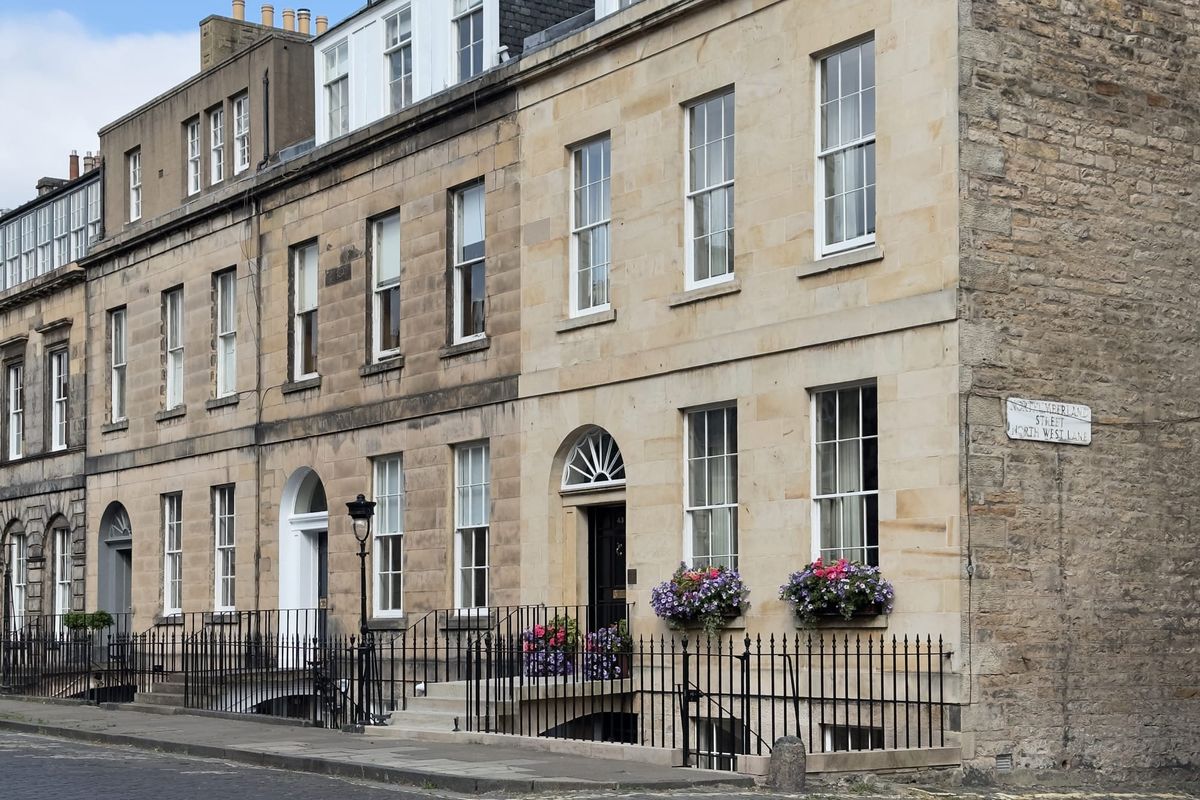
The hallmark of Edinburgh’s New Town is all the glorious golden sandstone quarried from the Lower Carboniferous sandstone at Craigleith quarry. There’s nothing prettier than walking along Heriot Row on a sunny, crisp autumn afternoon with the amber, gold, and red leaves of the trees in Queen Street Gardens on one side and the radiant honey townhouses on the other. It’s easy to stroll these streets now without having to think of the lives sacrificed — not only below the collapse of North Bridge — to the greed of industry.
For every medical advancement credited to the Victorian era — the discovery of germ theory, chloroform, aspirin, and even heart surgery — it’s critical to remember how much we didn’t understand. In the 18th and 19th centuries, respiratory masks were an unheard-of precaution. But that doesn’t mean the need for respiratory protection was unknown. Masons cut, sanded, and shaped blocks of sandstone and inhaled the fine quartz dust. The same was true of knife grinders, miners, and other professions. A Dutch anatomist reported in 1672:
In the year 1649 I dissected a stone cutter’s boy that dy'd of an asthma, in whose lungs I found a great quantity of stone dust suck’d in with the air and stuffing almost all the vessels […] so that the vessels being filled with dust, could not admit the air, which was the occasion of the poor fellow’s death.
In 1796, James Johnson, a physician from Worcester, suggested some protective measures:
Nor would it be difficult to contrive a crape hood of gauze helmet, to receive the head and rest on the shoulders, which would prevent a great deal of the […] stony particles of dust […]
But stonemasons died of “consumption” at an alarming rate while constructing New Town. While building the Cramond Bridge, two out of twenty-seven apprentices survived twenty-six years later. Only ten of the one hundred and twenty hewers employed in constructing the Edinburgh High School lived to see its completion. Many of those surviving ten died in the ensuing decades. Few stonemasons reached the age of fifty without significant symptoms of silicosis.
Scottish stonemasons paid a disproportionately high price for the gorgeous buildings forming our UNESCO World Heritage site. Industry representatives have stated that although it yielded beautiful bridges and homes, Craigleith stone was “the worst stone that has ever been known” for causing lung disease because of its high quartz content. In Scotland the building industry depended on stone to a greater degree than in England where brick predominated. Additionally, unlike their southern fellows, Scottish stonemasons worked in sheds rather than in the open air. Without respiratory protection or the wind to disperse quartz dust, it’s no wonder those masons dropped dead.
Why build a new town?
With all the dead stone masons, competing options, and collapsing bridges, why did the city council want to build a new town in the bare, exposed fields north of town? They’re all dead and can’t argue for their civic-minded reasons; therefore, the most obvious one presents itself: money.
From the perspective of a twentieth-century American — particularly one who grew up in New York where no civic development occurs without graft — it’s easy to see the money motive. But we acknowledge that neither George nor his architect, James Craig, became dramatically richer thanks to their association with the New Town project. They both belonged to the social class where being involved in the great social works of the time meant improving your bottom line, but we can’t ignore that New Town genuinely was a better place to live. Not only for the wealthy.
The sale of houses raised between £1,500 and £3,000 per home — annual rental on those homes cost between £100 and £200 — with tax money swelling the city coffers. (£100,000–£250,000 in 2026 money.) Swollen coffers meant the city could afford to build essential bridges. But as the population exploded, the city could also afford to improve the sewers and public water system. By the 1820s, New Town boasted over 1,000 buildings with a population over 20,000 at a substantially more salubrious standard of living.
It’s easy to look at New Town and see a dramatic departure from the egalitarian history of Scotland. However, Craig’s plan explicitly called for tenement buildings where families of more modest means — but not poor, oh gods, not the poor — might live. These buildings often fronted on busier streets and lacked back gardens or stables, but they were a critical stepping stone for many families.
After its initial chilly reception, New Town proved irresistible prompting Drummond and Craig to rush development on a second instalment, including Heriot Row, Abercromby Place, and Great King Street, which began in 1801. Even a financial panic in the spring of 1823 wasn’t sufficient to quench the ardour for New Town development, as builders broke ground on Moray Place. Nothing could stop the boom.
Technology incubator
Everywhere you looked in the nineteenth-century you saw something new: the soda fountain, the mackintosh, Portland cement and later reinforced concrete, matches, ice machines, the revolver, the telegraph, the sewing machine, and pasteurisation. New Town acted as a nineteenth-century technology incubator, both for domestic technologies and for the people who created them.
For the first time, homes were connected to modern municipal services for gas, water, and sewer during construction. Previously, in Old Town, residents bought their water from “caddies” because the municipal pipes didn’t reach most homes and pumping your water wasn’t done by the right people. However, in New Town the Edinburgh Water Company delivered “clean” water to your home and piped your waste hygienically into the Water of Leith. You might even have a bathroom with a bathtub. And by the 1880s, if you were wealthy, a hot water tap to fill it.
Because of a deep-seated fear of birds, Robert Thomson invented the refillable fountain pen while living at Moray Place in 1849. He also fiddled around with rubber and invented the pneumatic tyre, but that never went anywhere. Inventors, future inventors, or plain smart people were thick on the ground in New Town throughout the nineteenth and twentieth centuries. There might even be one or two living there now.